Carbonaceous components (e.g., black carbon (BC), organic carbon (OC)) play an important role on the global climate
change and enhancing the glacier melt, which has triggered out a lot of interest and related studies. Based on the recent research of this
topic, we reviewed the spatial and temporal characteristics of carbonaceous components in snow and ice in the Third Pole region. The
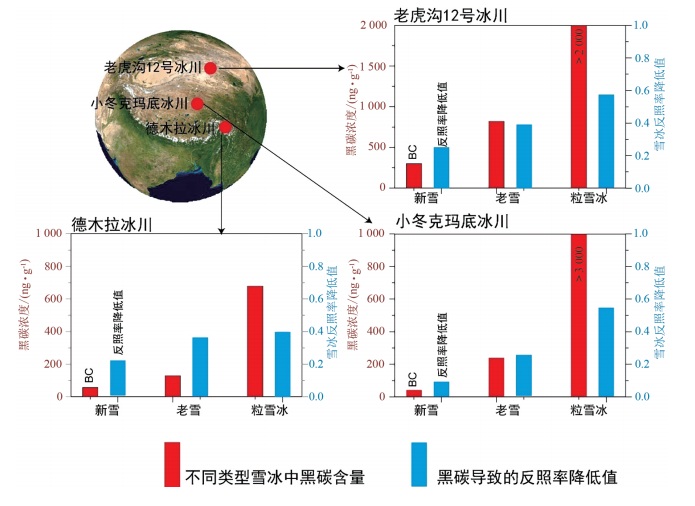
results indicated those BC and OC concentrations in aged snow (or firn ice) showed much higher than that in snowpit and fresh snow,
which enhanced our understanding on the carbonaceous component in different snow types in one entire glacier. Isotopic signature
of BC in snowpit revealed that BC deposited on glaciers in the northern Tibetan Plateau mainly originated from anthropogenic
emissions. However, in the central plateau, BC from biomass burning combustion contributed largely to the BC deposition on glaciers.
In Himalayas, equal contributions from fossil fuel and biomass combustion to BC in snowpit were found. Radiative forcing caused
by BC can reach to hundreds of W·m-2, further accelerating the glacier melting and reducing snow cover duration days. In the future,
studies on the sources of carbonaceous components and their impact on the radiative forcing should be enhanced. These results will
be served as a valuable scientific basis for the forecasting contributions of carbonaceous components to glacier melting under climate
change.
ZHANG Yulan, LUO Xi, KANG Shichang, GAO Tanguang, HU Zhaofu
. Carbonaceous components in snow and ice in the Third Pole region [J]. Chinese Journal of Nature, 2020
, 42(5)
: 393
-400
.
DOI: 10.3969/j.issn.0253-9608.2020.05.006

