
Molecular insights into mechanisms of cohesin in genome maintenance
Received date: 2019-08-01
Online published: 2021-02-25
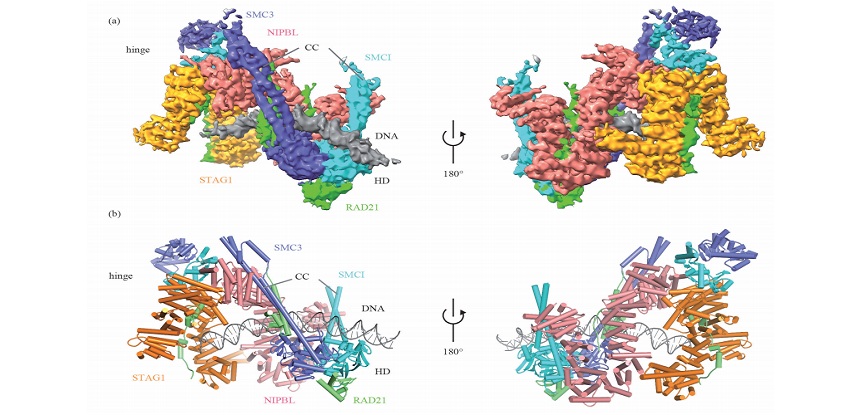
SHI Zhubing, BAI Xiaochen, YU Hongtao . Molecular insights into mechanisms of cohesin in genome maintenance[J]. Chinese Journal of Nature, 2021 , 43(1) : 1 -8 . DOI: 10.3969/j.issn.0253-9608.2020.00.003
[1] CALLAN H G. The Croonian Lecture, 1981. Lampbrush chromosomes [J]. Proc R Soc Lond B Biol Sci, 1982, 214: 417-448.
[2] YATSKEVICH S, RHODES J, NASMYTH K. Organization of chromosomal DNA by SMC complexes [J]. Annu Rev Genet, 2019, 53: 445-482.
[3] ROWLEY M J, CORCES V G. Organizational principles of 3D genome architecture [J]. Nat Rev Genet, 2018, 19: 789-800. [4] UHLMANN F. SMC complexes: from DNA to chromosomes [J]. Nat Rev Mol Cell Biol, 2016, 17: 399-412.
[5] HIRANO T. Condensin-based chromosome organization from bacteria to vertebrates [J]. Cell, 2016, 164: 847-857.
[6] ZHENG G, YU H. Regulation of sister chromatid cohesion during the mitotic cell cycle [J]. Sci China Life Sci, 2015, 58: 1089-1098.
[7] PETERS J M, NISHIYAMA T. Sister chromatid cohesion [J]. Cold Spring Harb Perspect Biol, 2012, 4: a011130.
[8] ONN I, HEIDINGER-PAULI J M, GUACCI V, et al. Sister chromatid cohesion: a simple concept with a complex reality [J]. Annu Rev Cell Dev Biol, 2008, 24: 105-129.
[9] OUYANG Z, YU H. Releasing the cohesin ring: A rigid scaffold model for opening the DNA exit gate by Pds5 and Wapl [J]. Bioessays, 2017, 39: 1600207.
[10] GUACCI V, KOSHLAND D, STRUNNIKOV A. A direct link between sister chromatid cohesion and chromosome condensation revealed through the analysis of MCD1 in S. cerevisiae [J]. Cell, 1997, 91: 47-57.
[11] MICHAELIS C, CIOSK R, NASMYTH K. Cohesins: chromosomal proteins that prevent premature separation of sister chromatids [J]. Cell, 1997, 91: 35-45.
[12] LOSADA A, HIRANO M, HIRANO T. Identification of Xenopus SMC protein complexes required for sister chromatid cohesion [J]. Genes Dev, 1998, 12: 1986-1997.
[13] STRUNNIKOV A V, LARIONOV V L, KOSHLAND D. SMC1: an essential yeast gene encoding a putative head-rod-tail protein is required for nuclear division and defines a new ubiquitous protein family [J]. J Cell Biol, 1993, 123: 1635-1648.
[14] TOTH A, CIOSK R, UHLMANN F, et al. Yeast cohesin complex requires a conserved protein, Eco1p(Ctf7), to establish cohesion between sister chromatids during DNA replication [J]. Genes Dev, 1999, 13: 320-333.
[15] LOSADA A, YOKOCHI T, KOBAYASHI R, et al. Identification and characterization of SA/Scc3p subunits in the Xenopus and human cohesin complexes [J]. J Cell Biol, 2000, 150: 405-416.
[16] SUMARA I, VORLAUFER E, GIEFFERS C, et al. Characterization of vertebrate cohesin complexes and their regulation in prophase [J]. J Cell Biol, 2000, 151: 749-762.
[17] CIOSK R, SHIRAYAMA M, SHEVCHENKO A, et al. Cohesin’s binding to chromosomes depends on a separate complex consisting of Scc2 and Scc4 proteins [J]. Mol Cell, 2000, 5: 243-254.
[18] OUYANG Z, ZHENG G, TOMCHICK D R, et al. Structural basis and IP6 requirement for Pds5-dependent cohesin dynamics [J]. Mol Cell, 2016, 62: 248-259.
[19] SHINTOMI K, HIRANO T. Releasing cohesin from chromosome arms in early mitosis: opposing actions of Wapl-Pds5 and Sgo1 [J]. Genes Dev, 2009, 23: 2224-2236.
[20] SUTANI T, KAWAGUCHI T, KANNO R, et al. Budding yeast Wpl1(Rad61)-Pds5 complex counteracts sister chromatid cohesionestablishing reaction [J]. Curr Biol, 2009, 19: 492-497.
[21] GANDHI R, GILLESPIE P J, HIRANO T. Human Wapl is a cohesin-binding protein that promotes sister-chromatid resolution in mitotic prophase [J]. Curr Biol, 2006, 16: 2406-2417.
[22] KUENG S, HEGEMANN B, PETERS B H, et al. Wapl controls the dynamic association of cohesin with chromatin [J]. Cell, 2006, 127: 955-967. [23] UHLMANN F, NASMYTH K. Cohesion between sister chromatids must be established during DNA replication [J]. Curr Biol, 1998, 8: 1095-1101.
[24] ROLEF BEN-SHAHAR T, HEEGER S, LEHANE C, et al. Eco1-dependent cohesin acetylation during establishment of sister chromatid cohesion [J]. Science, 2008, 321: 563-566.
[25] ZHANG J, SHI X, LI Y, et al. Acetylation of Smc3 by Eco1 is required for S phase sister chromatid cohesion in both human and yeast [J]. Mol Cell, 2008, 31: 143-151.
[26] UNAL E, HEIDINGER-PAULI J M, KIM W, et al. A molecular determinant for the establishment of sister chromatid cohesion [J]. Science, 2008, 321: 566-569.
[27] ROWLAND B D, ROIG M B, NISHINO T, et al. Building sister chromatid cohesion: smc3 acetylation counteracts an antiestablishment activity [J]. Mol Cell, 2009, 33: 763-774.
[28] CHAN K L, GLIGORIS T, UPCHER W, et al. Pds5 promotes and protects cohesin acetylation [J]. Proc Natl Acad Sci USA, 2013, 110: 13020-13025.
[29] NISHIYAMA T, LADURNER R, SCHMITZ J, et al. Sororin mediates sister chromatid cohesion by antagonizing Wapl [J]. Cell, 2010, 143: 737-749.
[30] NISHIYAMA T, SYKORA M M, HUIS IN 'T VELD P J, et al. Aurora B and Cdk1 mediate Wapl activation and release of acetylated cohesin from chromosomes by phosphorylating Sororin [J]. Proc Natl Acad Sci USA, 2013, 110: 13404-13409.
[31] LOSADA A, HIRANO M, HIRANO T. Cohesin release is required for sister chromatid resolution, but not for condensin-mediated compaction, at the onset of mitosis [J]. Genes Dev, 2002, 16: 3004- 3016.
[32] SUMARA I, VORLAUFER E, STUKENBERG P T, et al. The dissociation of cohesin from chromosomes in prophase is regulated by Polo-like kinase [J]. Mol Cell, 2002, 9: 515-525.
[33] HARA K, ZHENG G, QU Q, et al. Structure of cohesin subcomplex pinpoints direct shugoshin-Wapl antagonism in centromeric cohesion [J]. Nat Struct Mol Biol, 2014, 21: 864-870.
[34] LIU H, RANKIN S, YU H. Phosphorylation-enabled binding of SGO1-PP2A to cohesin protects sororin and centromeric cohesion during mitosis [J]. Nat Cell Biol, 2013, 15: 40-49.
[35] COHEN-FIX O, PETERS J M, KIRSCHNER M W, et al. Anaphase initiation in Saccharomyces cerevisiae is controlled by the APCdependent degradation of the anaphase inhibitor Pds1p [J]. Genes Dev, 1996, 10: 3081-3093.
[36] FUNABIKI H, YAMANO H, KUMADA K, et al. Cut2 proteolysis required for sister-chromatid seperation in fission yeast [J]. Nature, 1996, 381: 438-441.
[37] ZOU H, MCGARRY T J, BERNAL T, et al. Identification of a vertebrate sister-chromatid separation inhibitor involved in transformation and tumorigenesis [J]. Science, 1999, 285: 418-422.
[38] CIOSK R, ZACHARIAE W, MICHAELIS C, et al. An ESP1/PDS1 complex regulates loss of sister chromatid cohesion at the metaphase to anaphase transition in yeast [J]. Cell, 1998, 93: 1067-1076.
[39] UHLMANN F, LOTTSPEICH F, NASMYTH K. Sister-chromatid separation at anaphase onset is promoted by cleavage of the cohesin subunit Scc1 [J]. Nature, 1999, 400: 37-42.
[40] HAUF S, WAIZENEGGER I C, PETERS J M. Cohesin cleavage by separase required for anaphase and cytokinesis in human cells [J]. Science, 2001, 293: 1320-1323.
[41] WAIZENEGGER I C, HAUF S, MEINKE A, et al. Two distinct pathways remove mammalian cohesin from chromosome arms in prophase and from centromeres in anaphase [J]. Cell, 2000, 103: 399-410.
[42] WATRIN E, KAISER F J, WENDT K S. Gene regulation and chromatin organization: relevance of cohesin mutations to human disease [J]. Curr Opin Genet Dev, 2016, 37: 59-66.
[43] LOSADA A. Cohesin in cancer: chromosome segregation and beyond [J]. Nat Rev Cancer, 2014, 14: 389-393.
[44] LIEBERMAN-AIDEN E, VAN BERKUM N L, WILLIAMS L, et al. Comprehensive mapping of long-range interactions reveals folding principles of the human genome [J]. Science, 2009, 326: 289-293.
[45] RAO S S, HUNTLEY M H, DURAND N C, et al. A 3D map of the human genome at kilobase resolution reveals principles of chromatin looping [J]. Cell, 2014, 159: 1665-1680.
[46] LARSON A G, ELNATAN D, KEENEN M M, et al. Liquid droplet formation by HP1alpha suggests a role for phase separation in heterochromatin [J]. Nature, 2017, 547: 236-240.
[47] DIXON J R, SELVARAJ S, YUE F, et al. Topological domains in mammalian genomes identified by analysis of chromatin interactions [J]. Nature, 2012, 485: 376-380.
[48] NORA E P, LAJOIE B R, SCHULZ E G, et al. Spatial partitioning of the regulatory landscape of the X-inactivation centre [J]. Nature, 2012, 485: 381-385.
[49] GUO Y, XU Q, CANZIO D, et al. CRISPR inversion of CTCF sites alters genome topology and enhancer/promoter function [J]. Cell, 2015, 162: 900-910.
[50] TEDESCHI A, WUTZ G, HUET S, et al. Wapl is an essential regulator of chromatin structure and chromosome segregation [J]. Nature, 2013, 501: 564-568.
[51] RAO S S P, HUANG S C, ST HILAIRE B G, et al. Cohesin loss eliminates all loop domains [J]. Cell, 2017, 171: 305-320.
[52] WUTZ G, VARNAI C, NAGASAKA K, et al. Topologically associating domains and chromatin loops depend on cohesin and are regulated by CTCF, WAPL, and PDS5 proteins [J]. EMBO J, 2017, 36: 3573-3599.
[53] GASSLER J, BRANDAO H B, IMAKAEV M, et al. A mechanism of cohesin-dependent loop extrusion organizes zygotic genome architecture [J]. EMBO J, 2017, 36: 3600-3618.
[54] HAARHUIS J H I, VAN DER WEIDE R H, BLOMEN V A, et al. The cohesin release factor WAPL restricts chromatin loop extension [J]. Cell, 2017, 169: 693-707.
[55] NASMYTH K. Disseminating the genome: joining, resolving, and separating sister chromatids during mitosis and meiosis [J]. Annu Rev Genet, 2001, 35: 673-745.
[56] ALIPOUR E, MARKO J F. Self-organization of domain structures by DNA-loop-extruding enzymes [J]. Nucleic Acids Res, 2012, 40: 11202-11212.
[57] FUDENBERG G, IMAKAEV M, LU C, et al. Formation of chromosomal domains by loop extrusion [J]. Cell Rep, 2016, 15: 2038-2049.
[58] SANBORN A L, RAO S S, HUANG S C, et al. Chromatin extrusion explains key features of loop and domain formation in wild-type and engineered genomes [J]. Proc Natl Acad Sci USA, 2015, 112: 6456- 6465.
[59] GOLOBORODKO A, IMAKAEV M V, MARKO J F, et al. Compaction and segregation of sister chromatids via active loop extrusion [J]. eLife, 2016, 5: e14864.
[60] GOLOBORODKO A, MARKO J F, MIRNY L A. Chromosome compaction by active loop extrusion [J]. Biophys J, 2016, 110: 2162-2168.
[61] DE WIT E, VOS E S, HOLWERDA S J, et al. CTCF binding polarity determines chromatin looping [J]. Mol Cell, 2015, 60: 676- 684.
[62] TANG Z, LUO O J, LI X, et al. CTCF-mediated human 3D genome architecture reveals chromatin topology for transcription [J]. Cell, 2015, 163: 1611-1627.
[63] DAVIDSON I F, BAUER B, GOETZ D, et al. DNA loop extrusion by human cohesin [J]. Science, 2019, 366: 1338-1345.
[64] KIM Y, SHI Z, ZHANG H, et al. Human cohesin compacts DNA by loop extrusion [J]. Science, 2019, 366: 1345-1349.
[65] GANJI M, SHALTIEL I A, BISHT S, et al. Real-time imaging of DNA loop extrusion by condensin [J]. Science, 2018, 360: 102-105.
[66] HAERING C H, FARCAS A M, ARUMUGAM P, et al. The cohesin ring concatenates sister DNA molecules [J]. Nature, 2008, 454: 297- 301.
[67] SRINIVASAN M, SCHEINOST J C, PETELA N J, et al. The cohesin ring uses its hinge to organize dna using non-topological as well as topological mechanisms [J]. Cell, 2018, 173: 1508-1519.
[68] BANIGAN E J, VAN DEN BERG A A, BRANDAO H B, et al. Chromosome organization by one-sided and two-sided loop extrusion [J]. eLife, 2020, 9: e53558.
[69] KURZE A, MICHIE K A, DIXON S E, et al. A positively charged channel within the Smc1/Smc3 hinge required for sister chromatid cohesion [J]. EMBO J, 2011, 30: 364-378.
[70] HAERING C H, LOWE J, HOCHWAGEN A, et al. Molecular architecture of SMC proteins and the yeast cohesin complex [J]. Mol Cell, 2002, 9: 773-788.
[71] HAERING C H, SCHOFFNEGGER D, NISHINO T, et al. Structure and stability of cohesin's Smc1-kleisin interaction [J]. Mol Cell, 2004, 15: 951-964.
[72] GLIGORIS T G, SCHEINOST J C, BURMANN F, et al. Closing the cohesin ring: structure and function of its Smc3-kleisin interface [J]. Science, 2014, 346: 963-967.
[73] GRUBER S, HAERING C H, NASMYTH K. Chromosomal cohesin forms a ring [J]. Cell, 2003, 112: 765-777.
[74] KIKUCHI S, BOREK D M, OTWINOWSKI Z, et al. Crystal structure of the cohesin loader Scc2 and insight into cohesinopathy [J]. Proc Natl Acad Sci USA, 2016, 113: 12444-12449.
[75] MUIR K W, KSCHONSAK M, LI Y, et al. Structure of the Pds5- Scc1 complex and implications for cohesin function [J]. Cell Rep, 2016, 14: 2116-2126. [76] LEE B G, ROIG M B, JANSMA M, et al. Crystal structure of the cohesin gatekeeper Pds5 and in complex with kleisin Scc1 [J]. Cell Rep, 2016, 14: 2108-2115. [77] LI Y, HAARHUIS J H I, SEDENO CACCIATORE A, et al. The structural basis for cohesin-CTCF-anchored loops [J]. Nature, 2020, 578: 472-476.
[78] PETELA N J, GLIGORIS T G, METSON J, et al. Scc2 is a potent activator of cohesin’s ATPase that promotes loading by binding Scc1 without Pds5 [J]. Mol Cell, 2018, 70: 1134-1148.
[79] ANDERSON D E, LOSADA A, ERICKSON H P, et al. Condensin and cohesin display different arm conformations with characteristic hinge angles [J]. J Cell Biol, 2002, 156: 419-424.
[80] HUIS IN 'T VELD P J, HERZOG F, LADURNER R, et al. Characterization of a DNA exit gate in the human cohesin ring [J]. Science, 2014, 346: 968-972.
[81] HONS M T, HUIS IN 'T VELD P J, KAESLER J, et al. Topology and structure of an engineered human cohesin complex bound to Pds5B [J]. Nat Commun, 2016, 7: 12523.
[82] BURMANN F, LEE B G, THAN T, et al. A folded conformation of MukBEF and cohesin [J]. Nat Struct Mol Biol, 2019, 26: 227-236.
[83] DIEBOLD-DURAND M L, LEE H, RUIZ AVILA L B, et al. Structure of full-length SMC and rearrangements required for chromosome organization [J]. Mol Cell, 2017, 67: 334-347.
[84] KAMADA K, SU'ETSUGU M, TAKADA H, et al. Overall shapes of the SMC-ScpAB complex are determined by balance between constraint and relaxation of its structural parts [J]. Structure, 2017, 25: 603-616.
[85] SOH Y M, BURMANN F, SHIN H C, et al. Molecular basis for SMC rod formation and its dissolution upon DNA binding [J]. Mol Cell, 2015, 57: 290-303.
[86] CHAPARD C, JONES R, VAN OEPEN T, et al. Sister DNA entrapment between juxtaposed Smc heads and kleisin of the cohesin complex [J]. Mol Cell, 2019, 75: 224-237.
[87] VAZQUEZ NUNEZ R, RUIZ AVILA L B, GRUBER S. Transient DNA occupancy of the SMC interarm space in prokaryotic condensin [J]. Mol Cell, 2019, 75: 209-223. [88] SHI Z, GAO H, BAI X C, et al. Cryo-EM structure of the human cohesin-NIPBL-DNA complex [J]. Science, 2020, 368: 1454-1459. [89] MURAYAMA Y, UHLMANN F. DNA entry into and exit out of the cohesin ring by an interlocking gate mechanism [J]. Cell, 2015, 163: 1628-1640.
[90] DAUBAN L, MONTAGNE R, THIERRY A, et al. Regulation of cohesin-mediated chromosome folding by Eco1 and other partners [J]. Mol Cell, 2020, 77: 1279-1293.
[91] LI Y, MUIR K W, BOWLER M W, et al. Structural basis for Scc3- dependent cohesin recruitment to chromatin [J]. eLife, 2018, 7: 38356.
[92] CHIU A, REVENKOVA E, JESSBERGER R. DNA interaction and dimerization of eukaryotic SMC hinge domains [J]. J Biol Chem, 2004, 279: 26233-26242.
[93] GRUBER S, ARUMUGAM P, KATOU Y, et al. Evidence that loading of cohesin onto chromosomes involves opening of its SMC hinge [J]. Cell, 2006, 127: 523-537.
[94] HASSLER M, SHALTIEL I A, HAERING C H. Towards a unified model of SMC complex function [J]. Curr Biol, 2018, 28: R1266-R1281.
[95] VAN RUITEN M S, ROWLAND B D. SMC complexes: universal DNA looping machines with distinct regulators [J]. Trends Genet, 2018, 34: 477-487. [96] WUTZ G, LADURNER R, ST HILAIRE B G, et al. ESCO1 and CTCF enable formation of long chromatin loops by protecting cohesin(STAG1) from WAPL [J]. eLife, 2020, 9: 52091.
[97] WALDMAN T. Emerging themes in cohesin cancer biology [J]. Nat Rev Cancer, 2020, 20: 504-515.
[98] KRANTZ I D, MCCALLUM J, DESCIPIO C, et al. Cornelia de Lange syndrome is caused by mutations in NIPBL, the human homolog of Drosophila melanogaster Nipped-B [J]. Nat Genet, 2004, 36: 631-635.
[99] TONKIN E T, WANG T J, LISGO S, et al. NIPBL, encoding a homolog of fungal Scc2-type sister chromatid cohesion proteins and fly Nipped-B, is mutated in cornelia de lange syndrome [J]. Nat Genet, 2004, 36: 636-641.
/
| 〈 |
|
〉 |
