
Interpret the latest parameter measurement results of Cygnus X-1
Received date: 2021-05-10
Online published: 2021-06-13
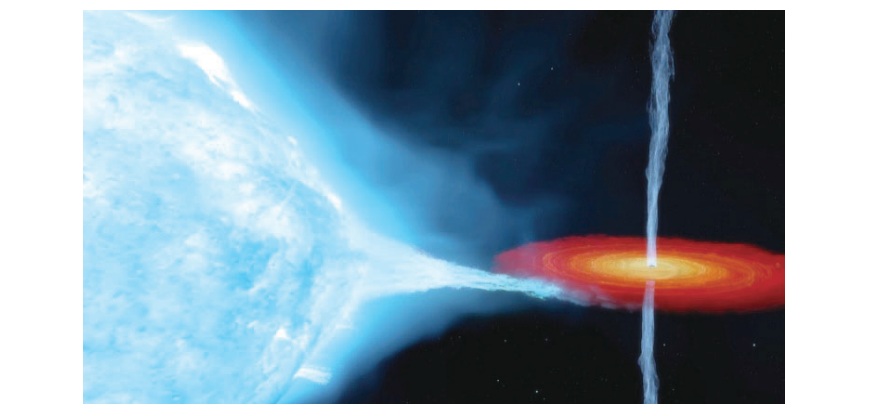
ZHAO Xueshan, FENG Ye, GOU Lijun . Interpret the latest parameter measurement results of Cygnus X-1[J]. Chinese Journal of Nature, 2021 , 43(3) : 209 -216 . DOI: 10.3969/j.issn.0253-9608.2021.03.006
[1] MIRABEL I F, RODRIGUES I. Formation of a black hole in the dark [J]. Science, 2003, 300: 1119-1120. DOI: 10.1126/science.1083451.
[2] REID M J, MCCLINTOCK J E, NARAYAN R, et al. The trigonometric parallax of Cygnus X-1 [J]. The Astrophysical Journal, 2011, 742: 83. DOI: 10.1088/0004-637X/742/2/83.
[3] OROSZ J A, MCCLINTOCK J E, AUFDENBERG J P, et al. The mass of the black hole in Cygnus X-1 [J]. The Astrophysical Journal, 2011, 742: 84. DOI: 10.1088/0004-637X/742/2/84.
[4] GOU L J, MCCLINTOCK J E, JEFFREY E, et al. The extreme spin of the black hole in Cygnus X-1 [J]. The Astrophysical Journal, 2011, 742: 85. DOI: 10.1088/0004-637X/742/2/85.
[5] MILLER-JONES J C A, BAHRAMIAN A, OROSZ J A, et al. Cygnus X-1 contains a 21-solar mass black hole – Implications for massive star winds [J]. Science, 2021, 371: 1046-1049. DOI: 10.1126/science. abb3363.
[6] NEIJSSEL C J, VINCIGUERRA S, VIGNA-GÓMEZ A, et al. Wind mass-loss rates of stripped stars inferred from Cygnus X-1 [J]. The Astrophysical Journal, 2021, 908: 118. DOI: 10.3847/1538-4357/abde4a.
[7] ZHAO X S, GOU L J, DONG Y T, et al. Re-estimating the spin parameter of the black hole in Cygnus X-1 [J]. The Astrophysical Journal, 2021, 908: 117. DOI: 10.3847/1538-4357/abbcd6.
[8] CABALLERO-NIEVES S M. The ultraviolet spectrum and physical properties of the Mass Donor Star in HD 226868 = Cygnus X-1 [J]. The Astrophysical Journal, 2009, 701: 1895-1905. DOI: 10.1088/0004- 637X/701/2/1895.
[9] LENNON D J, MAÍZ APELLÁNIZ J, IRRGANG A, et al. Hubble spectroscopy of LB-1: comparison with B+black-hole and Be+strippedstar models [J]. Astronomy and Astrophysics, 2021, 649: A167. DOI: 10.1051/0004-6361/202040253.
[10] BARDEEN J M, PRESS W H, TEUKOLSKY S A. Rotating black holes: locally nonrotating frames, energy extraction, and scalar synchrotron radiation [J]. The Astrophysical Journal, 1972, 178: 347-370.
[11] FABIAN A C, REES M J, STELLA L, et al. X-ray fluorescence from the inner disc in Cygnus X-1 [J]. Monthly Notices of the Royal Astronomical Society, 1989, 238: 729.
[12] ZHANG S N, CUI W, CHEN W. Black hole spin in X-Ray binaries: observational consequences [J]. The Astrophysical Journal, 1997, 482: L155.
[13] GOU L J, MCCLINTOCK J E, REMILLARD R A, et al. Confirmation via the continuum-fitting method that the spin of the black hole in Cygnus X-1 is extreme [J]. The Astrophysical Journal, 2014, 790: 29.
[14] QIN Y, MARCHANT P, FRAGOS T, et al. On the origin of black hole spin in high-mass X-Ray binaries [J]. The Astrophysical Journal Letters, 2019, 870: L18. DOI: 10.3847/2041-8213/aaf97b.
[15] EILBOTTT D H, RILEY A H, COHN J H, et al. Detecting binarity of GW150914-like lenses in gravitational microlensing events [J]. Monthly Notices of the Royal Astronomical Society: Letters, 2017, 467: L100. DOI: 10.1093/mnrasl/slx007.
[16] MICHELL J. On the means of discovering the distance, magnitude, & c. of the fixed stars, in consequence of the diminution of the velocity of their light, in case such a diminution should be found to take place in any of them, and such other data should be procured from observations, as would be farther necessary for that purpose [J]. Philosophical Transactions of the Royal Society of London, 1783, 74: 35-57.
[17] LAPLACEP S. Beweis des satzes, dass die anziehendekraft bey einem weltkörper so gross seyn könne, dass das licht davon nicht ausströmen kann [J]. Allgemeine Geographische Ephemeriden, 1799, 4: 1-6.
[18] SCHWARZSCHILD K. Über das gravitationsfeld enies mass enpunktes nach der Einsteinschen theorie [M]. Berlin: Sitzungsberichte der Königlich-Preussischen Akademi der Wissenschaften, 1916.
[19] KERR R P. Gravitational field of a spinning mass as an example of algebraically special metrics [J]. Physical Review Letters, 1963, 11(5): 237-238. DOI: 10.1103/PhysRevLett.11.237.
[20] PENROSE R. Gravitational collapse and space-time singularities [J]. Physical Review Letters, 1965, 14(3): 57-59. DOI: 10.1103/ PhysRevLett.14.57.
[21] PENROSE R, FLOYD R M. Extraction of rotational energy from a black hole [J]. Nature Physical Science, 1971, 229(6): 177-179. DOI: 10.1038/ physci229177a0.
[22] HAWKING S W. Black hole explosions [J]. Nature, 1974, 248(5443): 30- 31.
[23] HAWKING S W, PENROSE R. The singularities of gravitational collapse and cosmology [J]. Proc Roy SocLond A, 1970, 314: 529-548.
/
| 〈 |
|
〉 |
