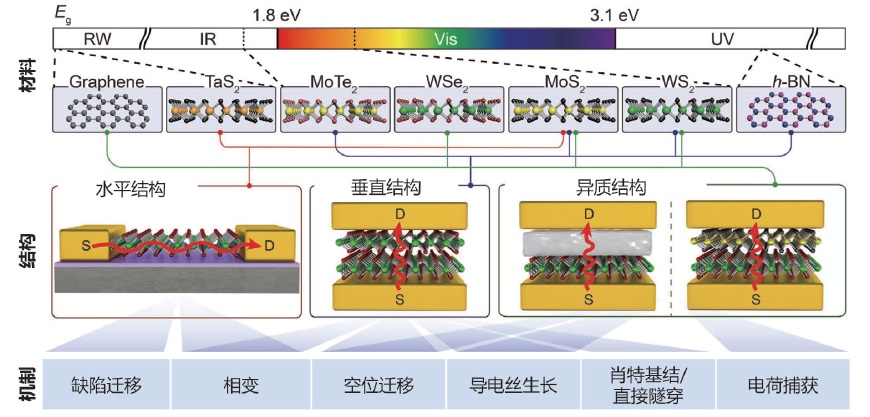
Two-dimensional materials are the most preferred candidates for neuromorphic devices with low power consumption, miniaturization and large-scale integration. In this paper, the recent progress, advantages and problems of the application of twodimensional materials in artificial intelligence are briefly reviewed, and future development trends are prospected.
ZHU Hongwei
. Application of two-dimensional materials in artificial intelligence[J]. Chinese Journal of Nature, 2022
, 44(6)
: 466
-468
.
DOI: 10.3969/j.issn.0253-9608.2022.06.006
[1] ROY K, JAISWAL A, PANDA P. Towards spike-based machine intelligence with neuromorphic computing [J]. Nature, 2019, 575(7784): 607-617.
[2] SANGWAN V K, HERSAM M C. Neuromorphic nanoelectronic materials [J]. Nature Nanotechnol, 2020, 15(7): 517-528.
[3] LIU C S, CHEN H W, WANG S Y, et al. Two-dimensional materials for next-generation computing technologies [J]. Nature
Nanotechnol, 2020, 15(7): 545-557.
[4] HUH W, LEE D, LEE C. Memristors based on 2D materials as an artificial synapse for neuromorphic electronics [J]. Adv Mater, 2020,
32(51): 2002092.
[5] NICHOLLS J G, MARTIN R A, FUCHS P A, et al. From neuron to brain [M]. Massachusetts, USA: Sinauer Associates, 2012.
[6] SUN P Z, WANG K L, ZHU H W. Recent developments in graphene-based membranes: structure, mass transport mechanism
and potential applications [J]. Adv Mater, 2016, 28(12): 2287-2310.