As the importance of photovoltaic (PV) power generation in global energy transition increases, the impact of particulate matter
(PM) dry deposition on PV systems has garnered growing attentions. This study investigates the effect of coarse particulate matter (PM10) dry
deposition on photovoltaic resources, particularly its influence on the irradiation received by PV panels, which subsequently affects energy
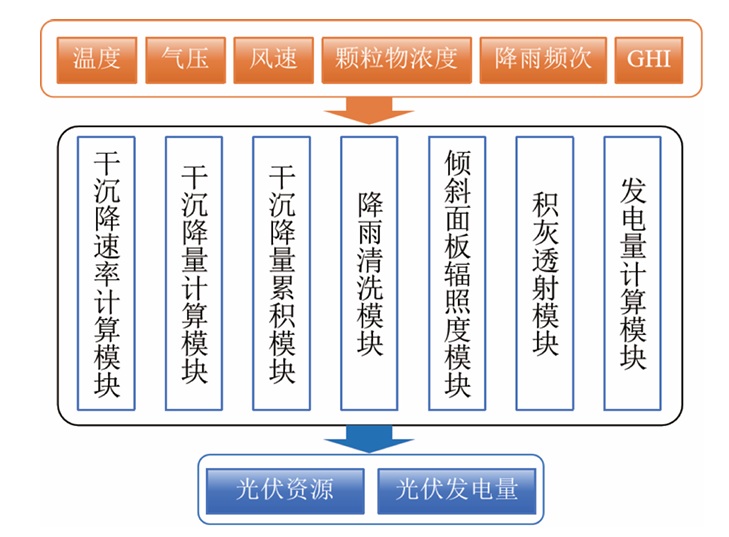
generation efficiency. A comprehensive PV resource assessment model was developed, incorporating factors such as particulate deposition
rate, meteorological conditions, and dust accumulation density to evaluate their impact on irradiation and power generation. The results
show that PM10 deposition forms a dust layer on the surface of PV panels, significantly reducing their transmittance. This leads to an average
reduction of about 10% in available solar energy resources nationwide. Notably, in northern China, higher PM10 deposition causes a reduction
in irradiation of approximately 600 kWh/m2, while in central and southern regions, the impact is less severe, with irradiation loss around 100
kWh/m2 due to the cleaning effect of rainfall. Seasonally, the reduction ratio is higher in winter and spring compared to summer and autumn.
A comparison of results from 2018 and 2020 shows that, despite a decrease in dry deposition flux in the latter year, the reduced rainfall
cleaning effect results in lower usable energy generation in 2020 compared to 2018. In conclusion, improving air quality and enhancing panel
cleaning can significantly boost PV power generation efficiency. The findings of this study are crucial for future PV resource assessments,
optimizing PV power generation strategies, and supporting the achievement of national carbon neutrality goals
HE Zhechen, LIU Nuohang, PEI Ziyue, SHI Hongrong, GE Baozhu, WANG Zifa
. Assessment of the impact of dry deposition of particulate matter on photovoltaic
resources[J]. Chinese Journal of Nature, 2025
, 47(4)
: 270
-280
.
DOI: 10.3969/j.issn.0253-9608.2025.04.004

