Infectious diseases caused by various virulent mosquito-borne viruses have been a major global public health challenge, but
there is still a lack of safe and effective prevention and control measures. In the virus transmission cycle, after mosquitoes acquire the
virus through blood-feeding, the virus sequentially infects their intestinal cells, hemocoel, and salivary glands, ultimately conferring
virus transmission capability to the mosquitoes. Notably, the mosquito gut, as a key tissue determining viral susceptibility, has its
microbial community significantly influenced by the living environment. This results in mosquitoes from different habitats exhibiting
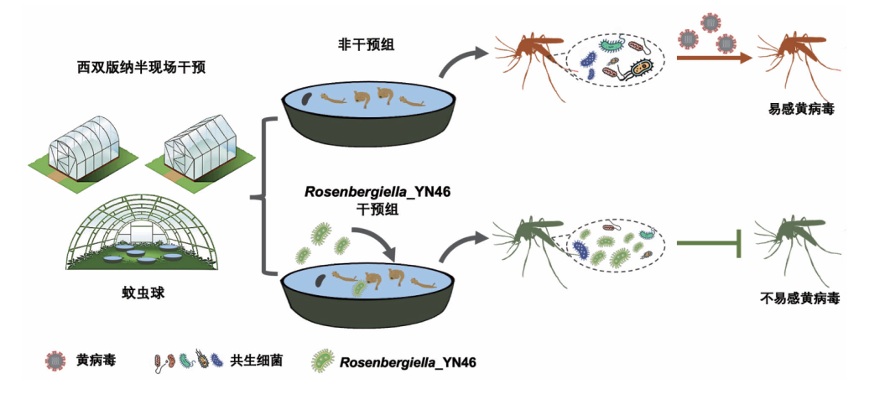
varying vector competence due to differences in their gut microbiota. Our team, in collaboration with partners, isolated a bacterium named Rosenbergiella_YN46 with significant antiviral activity from the gut of wild Aedes albopictus in Yunnan. This bacterium induces
acidification of the intestinal lumen by secreting glucose dehydrogenase, thereby effectively inhibiting infections by dengue virus and
Zika virus. Epidemiological surveys indicate that Rosenbergiella_YN46 is commonly present in mosquito populations in low-endemic
dengue areas, but relatively rare in high-endemic dengue areas. Semi-field environmental intervention experiments have confirmed that
this bacterium can significantly reduce the viral susceptibility of mosquitoes. This discovery provides a new environmentally friendly
biological control strategy for the prevention and control of mosquito-borne infectious diseases such as dengue fever.
ZHANG Liming, LI Juzhen, ZHU Yibin, CHENG Gong
. Intervention of symbiotic bacteria in the environment blocks the transmission of
mosquito-borne viruses[J]. Chinese Journal of Nature, 2025
, 47(5)
: 323
-329
.
DOI: 10.3969/j.issn.0253-9608.2025.05.001

