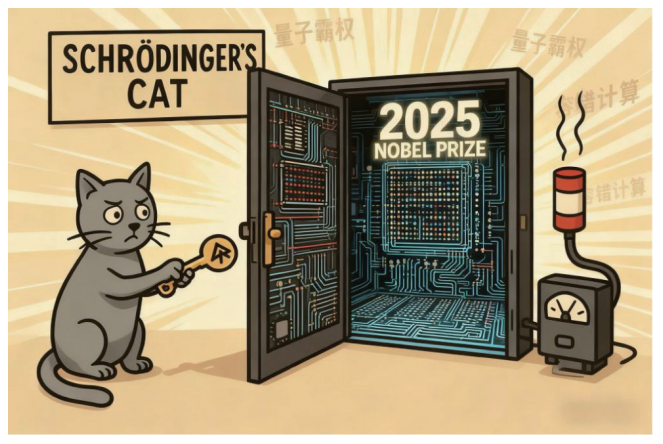
The 2025 Nobel Prize in Physics is awarded to John Clarke, Michel H. Devoret, and John M. Martinis for their groundbreaking experiments that led to the first observation of macroscopic quantum tunneling and energy quantization in an electrical circuit. Their work brought the famous thought experiment of “Schrödinger’s cat” to life. Using a centimeter-sized superconducting circuit, they successfully captured a macroscopic quantum superposition state composed of billions of collaboratively acting electron pairs. Their experiments not only demonstrated this macroscopic system tunneling through a classically impenetrable energy barrier but also revealed that its energy existed in discrete, staircase-like levels. This achievement fundamentally challenged the boundary that quantum phenomena are confined to the microscopic world. Furthermore, it laid the essential physical and experimental foundation for superconducting quantum computing technology. Today, the quantum bits (qubits) at the heart of quantum processors developed by companies like Google and IBM are built upon the Josephson junctions they pioneered, marking humanity’s transition from observing the quantum world to engineering it.