
Atomic structure of the photosynthetic reaction center from a green sulfur bacterium
Received date: 2021-03-05
Online published: 2021-06-13
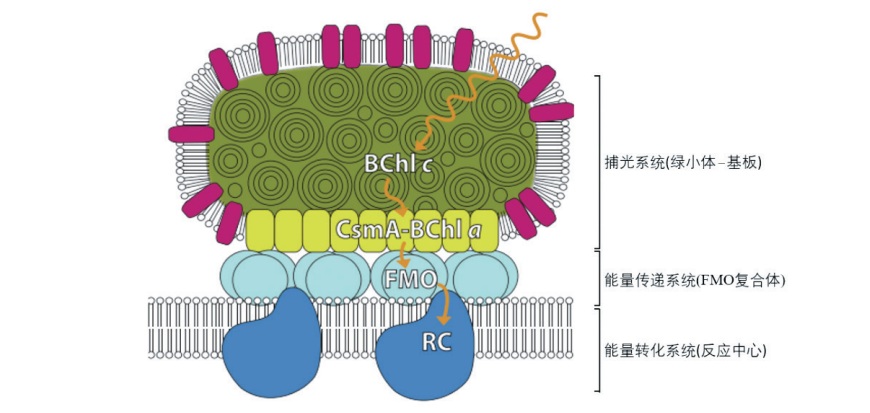
CHEN Jinghua, KUANG Tingyun, SHEN Jianren, ZHANG Xing . Atomic structure of the photosynthetic reaction center from a green sulfur bacterium[J]. Chinese Journal of Nature, 2021 , 43(3) : 189 -198 . DOI: 10.3969/j.issn.0253-9608.2021.03.004
[1] ALLEN J P, WILLIAMS J C. Photosynthetic reaction centers [J]. FEBS Letters, 1998, 438: 5-9.
[2] CARDONA T. A fresh look at the evolution and diversification of photochemical reaction centers [J]. Photosynthesis Research, 2015, 126: 111-134.
[3] DEISENHOFER J, EPP O, MIKI K, et al. Structure of the protein subunits in the photosynthetic reaction centre of Rhodopseudomonas viridis at 3 Å resolution [J]. Nature, 1985, 318: 618-624. [4] KARRASCH S, BULLOUGH P A, GHOSH R. The 8.5 Å projection map of the light-harvesting complex I from Rhodospirillum rubrum reveals a ring composed of 16 subunits [J]. The EMBO Journal, 1995, 14: 631-638.
[5] ALEKSANDER W R, TINA D H, JUNE S, et al. Crystal structure of the RC-LH1 core complex from Rhodopseudomonas palustris [J]. Science, 2003, 302: 1969-1972.
[6] QIAN P, PAPIZ M Z, JACKSON P J, et al. Three-dimensional structure of the Rhodobacter sphaeroides RC-LH1-PufX complex: dimerization and quinone channels promoted by PufX [J]. Biochemistry, 2013, 52: 7575-7585.
[7] JORDAN P, FROMME P, WITT H T, et al. Three-dimensional structure of cyanobacterial photosystem I at 2.5 Å resolution [J]. Nature, 2001, 411: 909-917.
[8] UMENA Y, KAWAKAMI K, SHEN J R, et al. Crystal structure of oxygen-evolving photosystem II at a resolution of 1.9 Å [J]. Nature, 2011, 473: 55-60.
[9] NIWA S, YU L J, TAKEDA K, et al. Structure of the LH1-RC complex from Thermochromatium tepidum at 3.0 Å [J]. Nature, 2014, 508: 228-232.
[10] GISRIEL C, SARROU I, FERLEZ B, et al. Structure of a symmetric photosynthetic reaction center–photosystem [J]. Science, 2017, 357: 1021-1025.
[11] YU L J, SUGA M, WANG-OTOMO Z Y, et al. Structure of photosynthetic LH1-RC supercomplex at 1.9 Å resolution [J]. Nature, 2018, 556: 209-213.
[12] XIN Y Y, SHI Y, NIU T, et al. Cryo-EM structure of the RC-LH core complex from an early branching photosynthetic prokaryote [J]. Nature Communications, 2018, 9: 1568. DOI: 10.1038/s41467-018- 03881-x.
[13] QIAN P, SIEBERT C A, WANG P, et al. Cryo-EM structure of the Blastochloris viridis LH1-RC complex at 2.9 Å [J]. Nature, 2018, 556: 203-208.
[14] CARDONA T, RUTHERFORD A W. Evolution of photochemical reaction centres: more twists [J]. Trends in Plant Science, 2019, 24: 1008-1021.
[15] CARDONA T. Thinking twice about the evolution of photosynthesis [J]. Open Biology, 2019, 9(9): 180246. DOI: 10.1098/rsob.180246.
[16] OLSON J M, BLANKENSHIP R E. Thinking about the evolution of photosynthesis [J]. Photosynthesis Research, 2004, 80: 373-386.
[17] HE Z, FERLEZ B, KURASHOV V, et al. Reaction centers of the thermophilic microaerophile, Chloracidobacterium thermophilum (Acidobacteria) I: biochemical and biophysical characterization [J]. Photosynthesis Research, 2019, 142: 87-103.
[18] BEATTY J T, OVERMANN J, LINCE M T, et al. An obligately photosynthetic bacterial anaerobe from a deep-sea hydrothermal vent [J]. Proceedings of the National Academy of Sciences of the United States of America, 2005, 102: 9306-9310.
[19] IMHOFF J F. The family chlorobiaceae [M]//ROSENBERG E, DELONG E F, LORY S, et al(eds). The Prokaryotes. Berlin: Springer, 2014. DOI: 10.1007/978-3-642-38954-2_142.
[20] 翁羽翔. 光合细菌分子自组装捕光天线相干激子态传能机制的人工模拟[J]. 物理, 2016, 45(12): 798-800. DOI: 10.7693/ wl20161207.
[21] WAHLUND T M, WOESE C R, CASTENHOLZ R W, et al. A thermophilic green sulfur bacterium from New Zealand hot springs, Chlorobium tepidum sp. nov [J]. Archives of Microbiology, 1991, 156: 81-90.
[22] PEDERSEN M Ø, UNDERHAUG J, DITTMER J, et al. The threedimensional structure of CsmA: a small antenna protein from the green sulfur bacterium Chlorobium tepidum [J]. FEBS Letters, 2008, 582: 2869-2874.
[23] HOHMANN-MARRIOTT M F, BLANKENSHIP R E, ROBERSON R W. The ultrastructure of Chlorobium tepidum chlorosomes revealed by electron microscopy [J]. Photosynthesis Research, 2005, 86: 145-154.
[24] ORF G S, BLANKENSHIP R E. Chlorosome antenna complexes from green photosynthetic bacteria [J]. Photosynthesis Research, 2013, 116: 315-331.
[25] NOZAWA T, OHTOMO K, SUZUKI M, et al. Structures of chlorosomes and aggregated BChlc in Chlorobium tepidum from solid state high resolution CP/MAS13C NMR [J]. Photosynthesis Research, 1994, 41: 211-223.
[26] OOSTERGETEL G T, VAN AMERONGEN H, BOEKEMA E J. The chlorosome: a prototype for efficient light harvesting in photosynthesis [J]. Photosynthesis Research, 2010, 104: 245-255.
[27] NIELSEN J T, KULMINSKAYA N V, BJERRING M, et al. In situ high-resolution structure of the baseplate antenna complex in Chlorobaculum tepidum [J]. Nature Communications, 2016, 7: 12454. DOI: 10.1038/ncomms12454.
[28] FENNA R E, MATTHEWS B W. Chlorophyll arrangement in a bacteriochlorophyll protein from Chlorobium limicola [J]. Nature, 1975, 258: 573-577.
[29] OLSON J M. The FMO protein [J]. Photosynthesis Research, 2004, 80: 181-187.
[30] CAMARA-ARTIGAS A, BLANKENSHIP R E, ALLEN J P. The structure of the FMO protein from Chlorobium tepidum at 2.2 Å resolution [J]. Photosynthesis Research, 2003, 75: 49-55.
[31] LARSON C R, SENG C O, LAUMAN L, et al. The threedimensional structure of the FMO protein from Pelodictyon phaeum and the implications for energy transfer [J]. Photosynthesis Research, 2011, 107: 139-150.
[32] KELL A, ACHARYA K, ZAZUBOVICH V, et al. On the controversial nature of the 825 nm exciton band in the FMO protein complex [J]. The Journal of Physical Chemistry Letters, 2014, 5: 1450-1456.
[33] KELL A, KHMELNITSKIY A Y, REINOT T, et al. On uncorrelated inter-monomer Forster energy transfer in Fenna-Matthews-Olson complexes [J]. Journal of the Royal Society Interface, 2019, 16: 20180882. DOI: 10.1098/rsif.2018.0882.
[34] HAUSKA G, SCHOEDL T, REMIGY H, et al. The reaction center of green sulfur bacteria [J]. Biochimica et Biophysica Acta (BBA) - Bioenergetics, 2001, 1507: 260-277.
[35] EISEN J A, NELSON K E, PAULSEN I T, et al. The complete genome sequence of Chlorobium tepidum TLS, a photosynthetic, anaerobic, green-sulfur bacterium [J]. Proceedings of the National Academy of Sciences of the United States of America, 2002, 99: 9509-9514.
[36] BUTTNER M, XIE D L, NELSON H, et al. The photosystem I-like P840-reaction center of green S-bacteria is a homodimer [J]. Biochimica et Biophysica Acta (BBA)-Bioenergetics, 1992, 1101: 154-156.
[37] BUTTNER M, XIE D L, NELSON H, et al. Photosynthetic reaction center genes in green sulfur bacteria and in photosystem I are related [J]. Proceedings of the National Academy of Sciences of the United States of America, 1992, 89: 8135-8139.
[38] TSUKATANI Y, MIYAMOTO R, ITOH S, et al. Function of a PscD subunit in a homodimeric reaction center complex of the photosynthetic green sulfur bacterium Chlorobium tepidum studied by insertional gene inactivation. Regulation of energy transfer and ferredoxin-mediated NADP+ reduction on the cytoplasmic side [J]. Journal of Biological Chemistry, 2004, 279: 51122-51130.
[39] HIRANO Y, HIGUCHI M, AZAI C, et al. Crystal structure of the electron carrier domain of the reaction center cytochrome c(z) subunit from green photosynthetic bacterium Chlorobium tepidum [J]. Journal of Molecular Biology, 2010, 397: 1175-1187.
[40] PERMENTIER H P, SCHMIDT K A, KOBAYASHI M, et al. Composition and optical properties of reaction centre core complexes from the green sulfur bacteria Prosthecochloris aestuarii and Chlorobium tepidum [J]. Photosynthesis Research, 2000, 64: 27-39.
[41] GRIESBECK C, HAGER-BRAUN C, ROGL H, et al. Quantitation of P840 reaction center preparations from Chlorobium tepidum: chlorophylls and FMO-protein [J]. Biochimica et Biophysica Acta (BBA)-Bioenergetics, 1998, 1365: 285-293.
[42] KOBAYASHI M, OH-OKA H, AKUTSU S, et al. The primary electron acceptor of green sulfur bacteria, bacteriochlorophyll 663, is chlorophyll a esterified with ∆2,6-phytadienol [J]. Photosynthesis Research, 2000, 63: 269-280.
[43] TSIOTIS G, HAGER-BRAUN C, WOLPENSINGER B, et al. Structural analysis of the photosynthetic reaction center from the green sulfur bacterium Chlorobium tepidum [J]. Biochimica et Biophysica Acta (BBA)-Bioenergetics, 1997, 1322: 163-172.
[44] REMIGY H W, STAHLBERG H, FOTIADIS D, et al. The reaction center complex from the green sulfur bacterium Chlorobium tepidum: a structural analysis by scanning transmission electron microscopy [J]. Journal of Molecular Biology, 1999, 290: 851-858.
[45] BÍNA D, GARDIAN Z, VÁCHA F, et al. Native FMO-reaction center supercomplex in green sulfur bacteria: an electron microscopy study [J]. Photosynthesis Research, 2016, 128: 93-102.
[46] CHEN J H, WU H, XU C, et al. Architecture of the photosynthetic complex from a green sulfur bacterium [J]. Science, 2020, 370(6519): eabb6350. DOI: 10.1126/science.abb6350.
[47] HAGER-BRAUN C, XIE D L, JAROSCH U, et al. Stable photobleaching of P840 in Chlorobium reaction center preparations: Presence of the 42-kDa bacteriochlorophyll a protein and a 17-kDa polypeptide [J]. Biochemistry, 1995, 34: 9617-9624.
[48] CAUSGROVE T P, BRUNE D C, WANG J, et al. Energy transfer kinetics in whole cells and isolated chlorosomes of green photosynthetic bacteria [J]. Photosynthesis Research, 1990, 26: 39-48.
[49] FETISOVA Z, FREIBERG A, TIMPMANN K. Long-range molecular order as an efficient strategy for light harvesting in photosynthesis [J]. Nature, 1988, 334: 633-634.
[50] FRANCKE C, OTTE S C M, MILLER M, et al. Energy transfer from carotenoid and FMO-protein in subcellular preparations from green sulfur bacteria. Spectroscopic characterization of an FMOreaction center core complex at low temperature [J]. Photosynthesis Research, 1996, 50: 71-77.
[51] NELSON N. Plant photosystem I—The most efficient nanophotochemical machine [J]. Journal of Nanoscience and Nanotechnology, 2009, 9: 1709-1713.
[52] HE G, NIEDZWIEDZKI D M, ORF G S, et al. Dynamics of energyand electron transfer in the FMO-reaction center core complex from the phototrophic green sulfur bacterium chlorobaculum tepidum [J]. The Journal of Physical Chemistry B, 2015, 119: 8321-8329.
[53] MAGDAONG N C M, NIEDZWIEDZKI D M, SAER R G, et al. Excitation energy transfer kinetics and efficiency in phototrophic green sulfur bacteria [J]. Biochimica et Biophysica Acta (BBA) - Bioenergetics, 2018, 1859: 1180-1190.
[54] QIN X, SUGA M, KUANG T, et al. Structural basis for energy transfer pathways in the plant PSI-LHCI supercomplex [J]. Science, 2015, 348: 989-995.
[55] MAZOR Y, BOROVIKOVA A, CASPY I, et al. Structure of the plant photosystem I supercomplex at 2.6 Å resolution [J]. Nature Plants, 2017, 3: 17014. DOI: 10.1038/nplants.2017.14.
[56] MÜH F, MADJET M E, ADOLPHS J, et al. α-helices direct excitation energy flow in the Fenna-Matthews-Olson protein [J]. Proceedings of the National Academy of Sciences of the United States of America, 2007, 104: 16862-16867.
/
| 〈 |
|
〉 |
