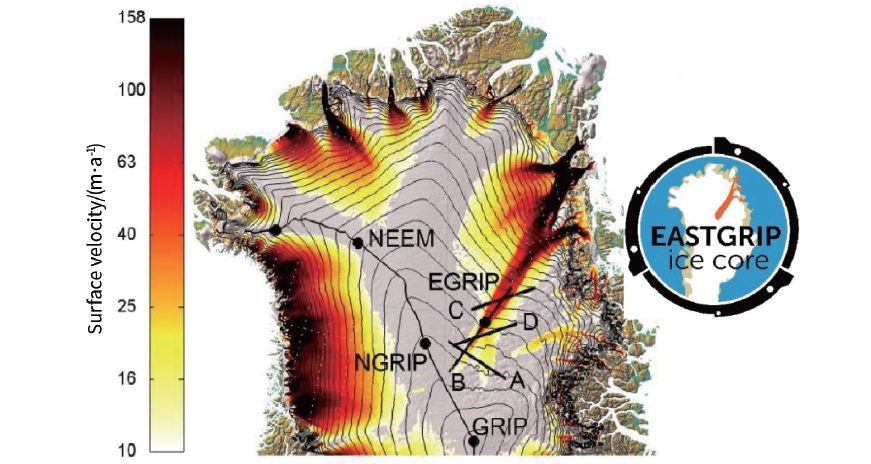
The base of the Greenland ice sheet holds crucial information on climate change, which is of scientific importance for understanding the future evolution of Earth's climate system. This paper reviews the involvement of the Chinese team in the Greenland deep ice core drilling project, discusses the connections between deep ice cores, ice sheets, and climate change, and explores future research directions in the field of ice sheet and climate instability
ZHANG Tong, XIAO Cunde
. Mysteries beneath the ice sheet: Path of deep exploration in Greenland[J]. Chinese Journal of Nature, 2024
, 46(6)
: 415
-420
.
DOI: 10.3969/j.issn.0253-9608.2024.06.003
[1] TAYLOR K C, HAMMER C U, ALLEY R B, et al. Electrical conductivity measurements from the GISP2 and GRIP Greenland ice cores [J]. Nature, 1993, 366: 549-552.
[2] XIAO C, DU Z, HANDLEY M J, et al. Iron in the NEEM ice core relative to Asian loess records over the last glacial-interglacial cycle
[J]. National Science Review, 2021, 8(7): nwaa144.
[3] NEEM community members. Eemian interglacial reconstructed from a Greenland folded ice core [J]. Nature, 2013, 493: 489-494.
[4] ZEISING O, HUMBERT A. Indication of high basal melting at the EastGRIP drill site on the Northeast Greenland Ice Stream [J]. The
Cryosphere, 2021, 15(7): 3119-3128.
[5] ZHANG T, COLGAN W, WANSING A, et al. Evaluating different geothermal heat flow maps as basal boundary conditions during
spin-up of the Greenland ice sheet [J]. The Cryosphere, 2024, 18(1): 387-402.