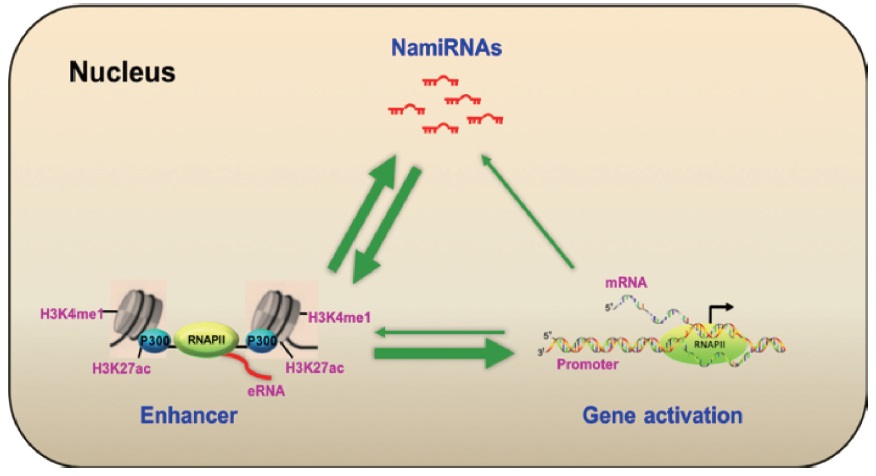
In 2024, American scientists Victor Ambros and Gary Ruvkun were awarded the Nobel Prize in Physiology or Medicine for their outstanding contributions in the field of microRNA (miRNA). miRNAs, a class of non-coding RNAs approximately 22 nucleotides in length, regulate gene expression at the post-transcriptional level through specific mechanisms and are involved in various biological processes. The research conducted by these two scientists not only established the central role of miRNAs in gene regulation but also opened up new avenues for medical applications. The current work not only elaborates on the classic negative regulatory mechanisms and physiological functions of miRNAs but also delves into a novel category of miRNAs within the nucleus, termed NamiRNAs. These unique miRNAs exhibit distinct activating effects by specifically targeting enhancer regions. This innovative discovery not only significantly broadens the horizons of miRNA research but also ushers in a new era of exploration into the activation mechanisms of nuclear miRNAs. miRNAs have demonstrated great potential as diagnostic markers and therapeutic targets for cancers, albeit facing challenges. As research progresses, miRNAs hold promise for achieving more breakthroughs in the medical field and offering new strategies for disease treatment.
LIANG Ying, YU Wenqiang
. The discovery journey of miRNA: An interpretation of the 2024 Nobel Prize in Physiology or Medicine[J]. Chinese Journal of Nature, 2024
, 46(6)
: 421
-428
.
DOI: 10.3969/j.issn.0253-9608.2024.06.004

