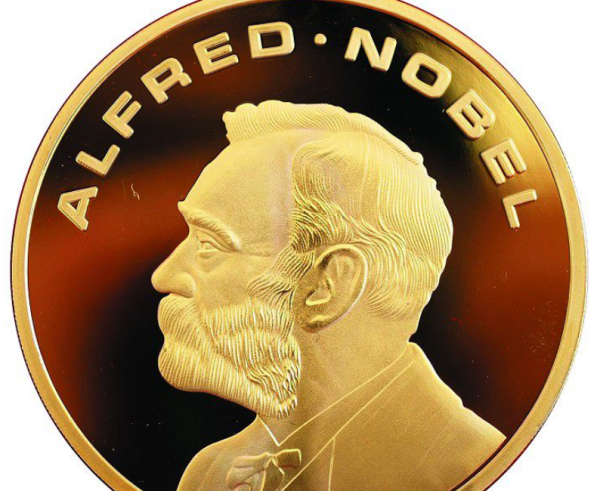
Evolution is an important power for the diversity of life. The directed evolution of enzymes was first conducted by Frances Arnold in 1993. Enzymes produced through directed evolution are used to manufacture everything from biofuels to pharmaceuticals. The phage display, which can be used to express protein on the surface of the phage, was first developed by George Smith in 1985. The antibody was first produced with phage display by Gregory Winter in 1990. Adalimumab, the human antibody based on phage display, was approved in 2002 and then widely used in the treatment of various immune diseases. So, the directed evolution of enzymes and the phage display of antibodies have brought the greatest benefit to humankind and laid the foundation for future chemical revolution. The three scientists, Frances Arnold, George Smith and Gregory Winter, shared the Nobel Prize in Chemistry 2018 for their groundbreaking discoveries. Here, the invention and application of the methods and the contributions of scientists are introduced.
Electron microscopes have a high resolving power to reveal the details of the micro world and are used to investigate the ultrastructure of a wide range of biological specimens. However, they were long believed to not suitable for imaging biological specimens to achieve high resolution structures, because the powerful electron beam would destroy biological material and some other challenges, until the advent of cryo-electron microscopy. In this paper, we briefly reviewed the history and methodological development of electron microscopy and cryo-electron microscopy in biological specimens.
The Royal Swedish Academy of Sciences decided to award Jean-Pierre Sauvage, J. Fraser Stoddart and Bernard L. Feringa the Nobel Prize in Chemistry 2016 for the design and synthesis of the molecular machines. In this article, we mainly introduced the concept of molecular machine and the achievement of the three scientists. Finally, the current problems and the challenges for future research were presented in this new field.