
专题综述

叶片扁平化的形成机制

展开
  • ①中国科学院大学 生命科学学院,北京 100049;②中国科学院遗传与发育生物学研究所 植物基因组学国家重 点实验室/国家植物基因研究中心(北京),中国科学院种子创新研究院,北京 100101;③中国科学院大学 现代农业科学学院,北京 100049

收稿日期: 2020-11-17

  网络出版日期: 2021-04-20

Mechanisms underlying leaf flattening

Expand
  • ①College of Life Sciences, University of Chinese Academy of Sciences, Beijing 100049, China; ②State Key Laboratory of Plant Genomics and National Center for Plant Gene Research (Beijing), Institute of Genetics and Developmental Biology, The Innovative Academy of Seed Design, Chinese Academy of Sciences, Beijing 100101, China; ③College of Advanced Agricultural Sciences, University of Chinese Academy of Sciences, Beijing 100049, China

Received date: 2020-11-17

  Online published: 2021-04-20

摘要

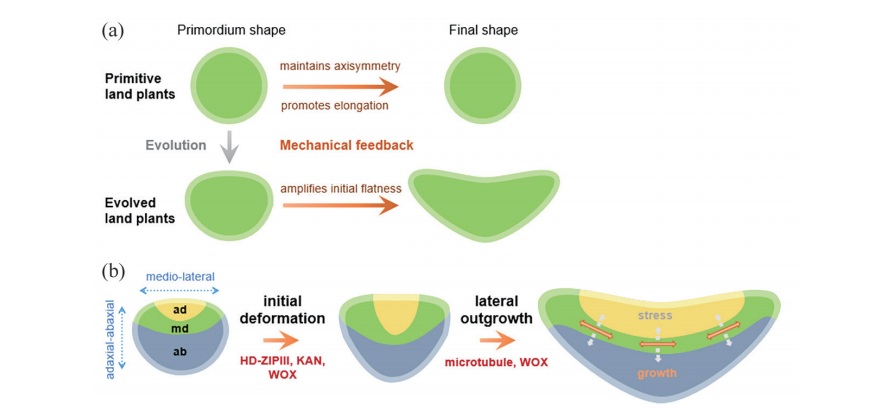
叶片是最为常见的植物侧生器官。扁平化是叶片形态的通常特征,对于增大光合作用面积具有显而易见的优势。叶片原基从接近半圆形的隆起快速形变,最终成为扁平化的叶片。经过70余年的研究,发育生物学家对叶片原基发育过程中的基因表达和形变机理有了逐步深入的认识。对叶片扁平发育机制的理解催生了在进化过程中扁平化叶片形成的新理论。

本文引用格式

汪颖, 焦雨铃 . 叶片扁平化的形成机制[J]. 自然杂志, 2021 , 43(2) : 79 -86 . DOI: 10.3969/j.issn.0253-9608.2021.02.001
Abstract

As the most typical lateral organ, leaf shape is usually flattened. Although flattened leaf shape is clearly beneficial to expand the area for photosynthesis, how it is achieved developmentally remains unanswered. Commonly, leaf primordia are close to half ball shaped right after initiation, but quickly acquire flattened shapes. Through research over the past 70 years, developmental biologists have obtained a deeper understanding of not only the gene regulatory networks but also the form acquisition process underlying leaf geometry changes. New theories have been proposed to explain leaf blade evolution, which broadly impacted on the Earth’s ecosystem.
文章导航

/
