
生物医药专刊

心肌梗死后造血系统的变化

展开
  • ①天津医科大学 生理与病理生理学系 天津市代谢病重点实验室,天津 300070;②中国医学科学院血液病医院(中国医学科学院血液学研究所) 实验血液学国家重点实验室,天津 300020

收稿日期: 2021-11-21

  网络出版日期: 2022-05-05

基金资助

国家自然科学基金委国家杰出青年科学基金项目(81925003)、国家自然科学基金委重大研究计划项目(91849105)

Changes in hematopoietic system after myocardial infarction

Expand
  • ①Tianjin Key Laboratory of Metabolic Diseases & Department of Physiology and Pathophysiology, Tianjin Medical University,
    Tianjin 300070, China; ②State Key Laboratory of Experimental Hematology & Institute of Hematology, Blood Diseases Hospital,
    Chinese Academy of Medical Sciences, Tianjin 300020, China

Received date: 2021-11-21

  Online published: 2022-05-05

摘要

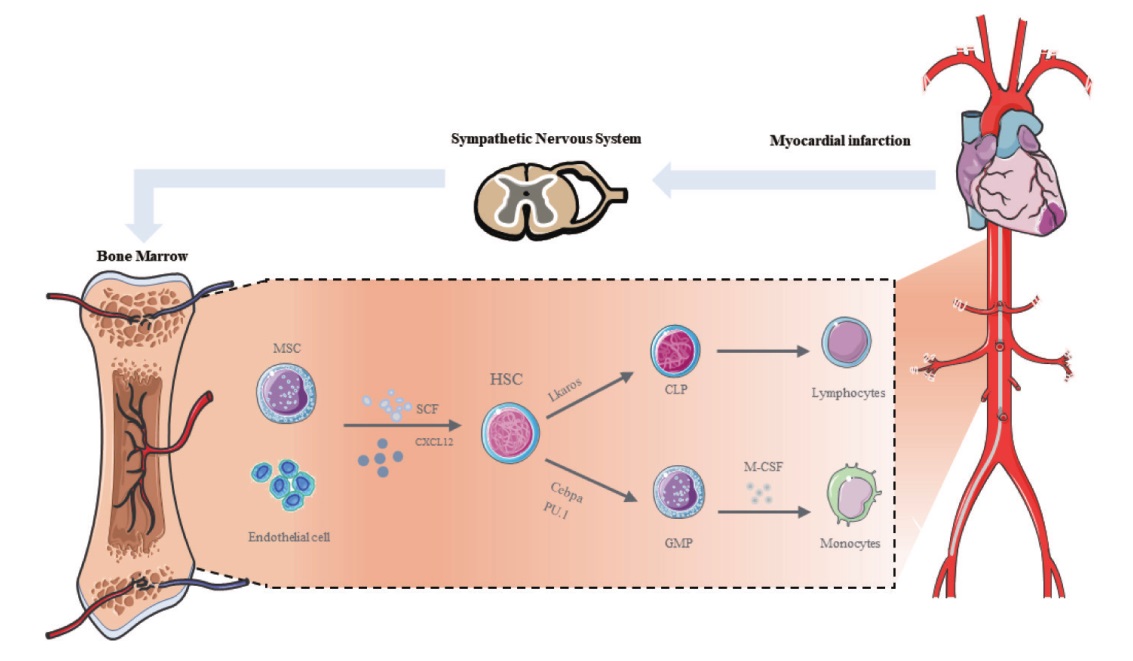
急性心肌梗死是因冠状动脉供血中断引起的急性、持续性局部缺血、缺氧引起的心肌坏死。心肌梗死可促进骨髓及髓外造血器官中造血干祖细胞的动员和分化,进而在心脏梗死部位的炎症反应和心脏功能修复中发挥重要作用,对其具体分子机制的研究将为临床治疗心肌梗死提供更多机遇。文章主要论述心肌梗死后造血系统变化。

本文引用格式

吕慧珍, 艾玎 . 心肌梗死后造血系统的变化[J]. 自然杂志, 2022 , 44(2) : 96 -102 . DOI: 10.3969/j.issn.0253-9608.2022.02.003
Abstract

Acute myocardial infarction (AMI) is the myocardial necrosis caused by coronary artery acute and persistent ischemia and hypoxia. The mobilization and differentiation of hematopoietic stem progenitor cells in bone marrow and extramedullary hematopoietic organs are enhanced after myocardial infarction, which plays an important role in the cardiac acute inflammation and cardiac function repair at the injured tissues to study the specific molecular mechanism will provide more opportunities for clinical
treatment of myocardial infarction. This paper mainly summarizes the research progress of changes in hematopoietic system after
myocardial infarction.
文章导航

/
