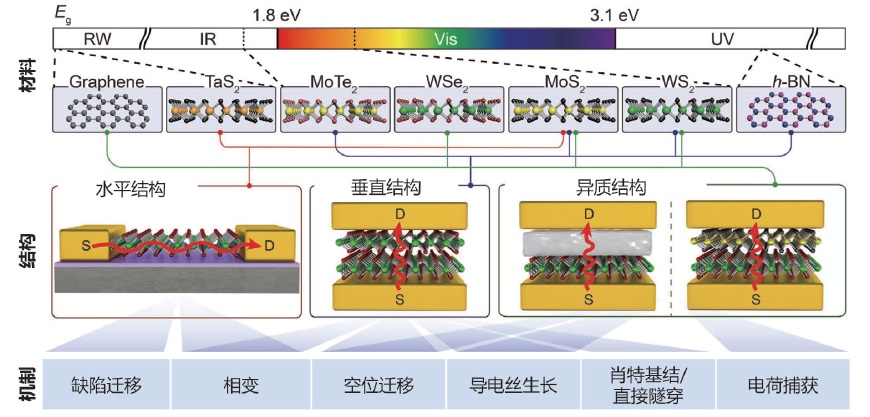
二维材料是构建神经形态器件并实现低功耗、微型化和规模化集成的首选材料体系。文章对二维材料在人工智能领域的应用现状、优势和面临的问题进行了简要评述,并对其发展趋势进行了展望。
Two-dimensional materials are the most preferred candidates for neuromorphic devices with low power consumption, miniaturization and large-scale integration. In this paper, the recent progress, advantages and problems of the application of twodimensional materials in artificial intelligence are briefly reviewed, and future development trends are prospected.
[1] ROY K, JAISWAL A, PANDA P. Towards spike-based machine intelligence with neuromorphic computing [J]. Nature, 2019, 575(7784): 607-617.
[2] SANGWAN V K, HERSAM M C. Neuromorphic nanoelectronic materials [J]. Nature Nanotechnol, 2020, 15(7): 517-528.
[3] LIU C S, CHEN H W, WANG S Y, et al. Two-dimensional materials for next-generation computing technologies [J]. Nature
Nanotechnol, 2020, 15(7): 545-557.
[4] HUH W, LEE D, LEE C. Memristors based on 2D materials as an artificial synapse for neuromorphic electronics [J]. Adv Mater, 2020,
32(51): 2002092.
[5] NICHOLLS J G, MARTIN R A, FUCHS P A, et al. From neuron to brain [M]. Massachusetts, USA: Sinauer Associates, 2012.
[6] SUN P Z, WANG K L, ZHU H W. Recent developments in graphene-based membranes: structure, mass transport mechanism
and potential applications [J]. Adv Mater, 2016, 28(12): 2287-2310.