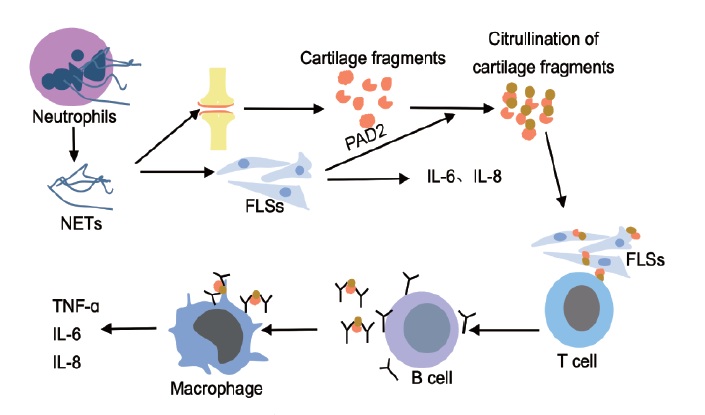
中性粒细胞胞外诱捕网(neutrophil extracellular traps, NETs)是激活的中性粒细胞,将去浓缩的核染色质和相关蛋白等释放至胞外而形成的网络结构。NETs可防止感染。然而,近年来发现NETs存在于多种疾病的病理环境中,并与疾病的发生和发展密切相关。文章就NETs在银屑病、系统性红斑狼疮(systemic lupus erythematosus, SLE)、类风湿关节炎(rheumatoid arthritis, RA)、抗中性粒细胞胞浆抗体(anti-neutrophil cytoplasmic antibodies, ANCA)相关血管炎(ANCA-associated vasculitis, AAV)、1型糖尿病(type 1 diabetes, T1D)等自身免疫病病理中的作用及机制的研究进展做简要综述。
Neutrophil extracellular traps (NETs) are networks of extracellular structures, primarily composed of decondensed nuclear chromatin and associated proteins, which are released by activated neutrophils. NETs protect against infection. Recently, they have also been found to exist in pathological environments of various diseases and are closely related to the occurrence and development of diseases. In this review, we briefly summarize the research progress in the roles and mechanisms of NETs in pathogenesis of several autoimmune diseases such as psoriasis, systemic lupus erythematosus (SLE), rheumatoid arthritis (RA), anti-neutrophil cytoplasmic antibodies (ANCA)-associated vasculitis (AAV), and type 1 diabetes (T1D).