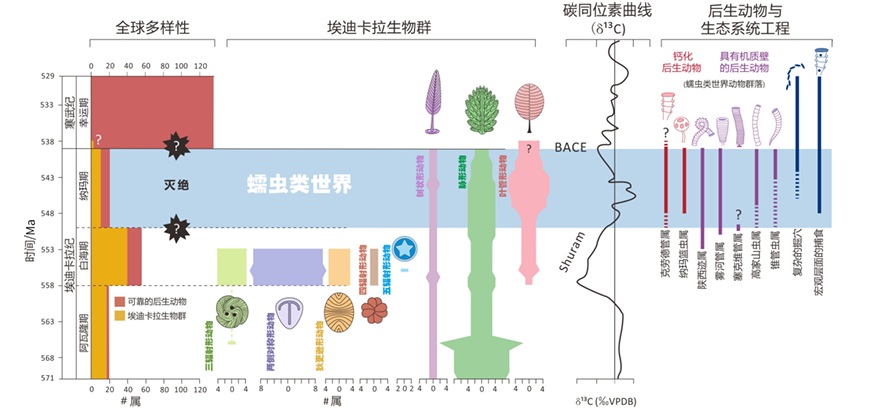
本文提出寒武纪大爆发不仅仅是地球多门类后生动物的系统性快速辐射事件,而且是地球动物生态系统的建立和动物消费驱动的生态革命事件。自此,地球生态系统自前寒武纪菌藻类支持的两极食物链生态系统向以动物消费驱动的三极食物链生态系统转变。在早期研究的基础上,本文强调了基于生命物质的组织层次(organismal hierarchical level)及其地质背景,并将地球早期生命宏演化划分为分子水平进化、细胞水平进化和组织水平进化三大阶段,分别导致了原核生物界、
原生生物界和多细胞化的动物界(Metazoa)三大生物界的起源。据此, 认为寒武纪大爆发的实质是真核细胞群“组织化”的必然结果,重点论述了寒武纪动物大爆发组织拼图新假说(Lego Blocks of Tissues Hypothesis)。埃迪卡拉纪末期地球磁场减弱、辐射增强、海水氧化程度增高为动物组织演化提供了环境背景。同时,动物组织的起源为动物器官系统的分化和躯体构型的辐射演化提供了物质基础,加速了多门类、高阶元动物门类的爆发性出现和快速辐射。
This paper argues that the Cambrian explosion did not only signify a rapid phylogenetic radiation of many kinds of
multicellular metazoans on the Earth, but also created the first Animal Consumer-Driven Marine Ecosystem on the Earth. Since
then, the Earth’s ecosystem has transformed from the Precambrian Bacteria-algae (producers and decomposers) supported
Preliminary Evolutionary Ecosystem to the first Animal Consumer-driven Primary Evolutionary Ecosystem with complex trophic
webs (producers, decomposers and consumers) on the Earth. On the basis of earlier studies, this paper emphasizes that the macro
evolution of early life on the Earth can be divided into three stages: molecular level evolution, cellular level evolution and tissue
level evolution based on the organismal hierarchical level of living organisms and its geological background. The three evolutionary
stages led respectively to the origin of prokaryotes, protists and multicellular Metazoa (animal kingdom). Based on this framework,
the Cambrian explosion is viewed as the inevitable outcome of the organization of protozoan cell clusters and reinterprets the new
Lego Blocks of Tissues Hypothesis of the Cambrian explosion. At the end of Ediacaran, the weakening of the Earth’s magnetic field,
increased radiation and the oxidation of seawater provided the environmental background for the evolution of animal tissues. At the
same time, the origin of animal tissues provided the material basis for the differentiation of animal organ systems and the evolution of
body configuration, and accelerated the explosive emergence and rapid radiation of multi-phyla and higher-order animal phyla.