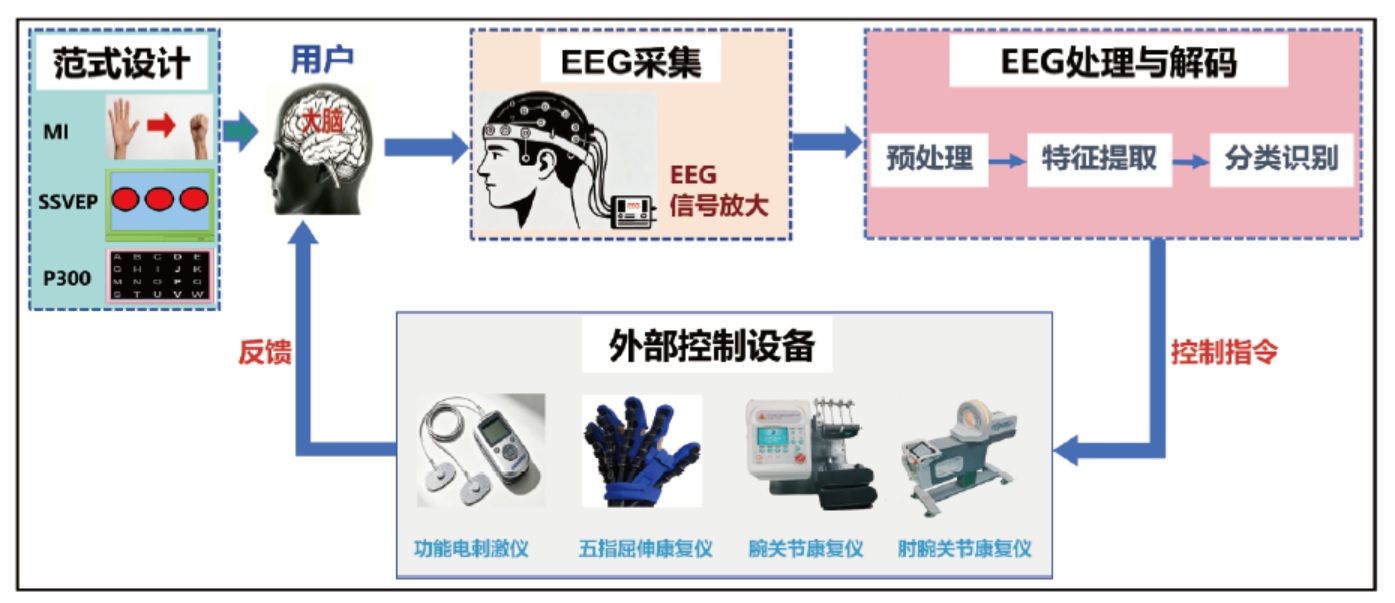
无创运动想象脑机接口(motor imagery-based brain–computer interface, MI-BCI)是一种通过解码大脑运动想象活动实现人机直接交互的关键技术,在神经康复与智能控制等领域具有重要的应用潜力。本文围绕无创MI-BCI系统的关键技术,系统梳理电极技术与信号采集、运动想象任务编码范式及公开数据集的发展现状,重点分析基于传统机器学习与深度学习的脑电解码算法及其性能提升机制。在此基础上,归纳当前无创MI-BCI在信号非平稳性、低信噪比及跨被试泛化能力等方面的关键挑战,并总结其在神经康复等临床场景中的应用进展。最后,展望了无创MI-BCI关键技术的发展趋势及其临床应用前景。
Non-invasive motor imagery-based brain–computer interface (MI-BCI) is a key technology that enables direct human-computer interaction by decoding brain motor imagery activity, and has important application potential in fields such as neurorehabilitation and intelligent control. This paper systematically reviews the current state of key technologies used in non-invasive MI-BCI systems, including electrode technology and signal acquisition, motor imagery task encoding paradigms, and publicly available datasets. It focuses on analyzing electroencephalogram (EEG) decoding methods based on conventional machine learning and deep learning, as well as their performance improvement mechanisms. On this basis, it summarizes the key challenges faced by current non-invasive MI-BCI systems, such as signal non-stationarity, low signal-to-noise ratio, and poor cross-subject generalization capability, and reviews their application progress in clinical scenarios including neurorehabilitation. Finally, it provides an outlook on the development trends of key technologies and the clinical application prospects of non-invasive MI-BCI.