近年来二维过渡金属硫族化合物(transition metal dichalcogenides, TMDs)展现了优异的电输运性质。为了理解其结
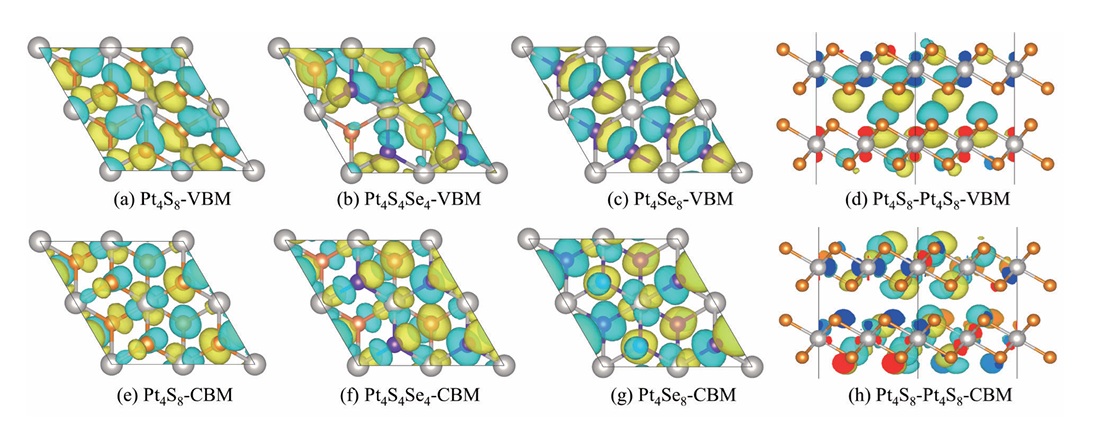
构与性能的关系,本文利用第一性原理计算,深入研究了Se元素替换及双层堆垛对单层TMDs材料PtS2电子结构及迁移率的影响,同时阐明了其背后的机理。研究发现,Se元素替换和双层堆垛均对价带顶附近的电子结构影响较大。电子结构的变化,使得单层结构的空穴迁移率随着元素替换数量的增加而减小,而双层堆垛能够较大幅度提升空穴迁移率。例如,在300
K下,由于等效电声耦合强度的减弱,在单层PtS2上堆垛一层PtS2或PtSe2均可将空穴迁移率提升一个数量级。因此,堆垛是一种提升TMDs电输运性质的有效策略。我们的工作为进一步优化二维TMDs材料的电输运性质提供了理论指导。
The excellent electrical transport properties of transition metal dichalcogenides (TMDs) materials have been demonstrated
in recent years. To understand the relationship between structure and properties, first-principles calculations are carried out to study
the electronic structure and mobility in two-dimensional PtS2-like systems. The effects of Se substitution and double-layer stacking
on the effective mass, electron-acoustic phonon coupling, and mobility are analyzed, revealing the influences on electrical transport
properties. It is found that Se substitution and layer-stacking both have more influences on the valance band maximum than the
conduction band minimum. Furthermore, the hole mobility in monolayer Pt(S1-xSex)2 decreases with the increase of Se concentration
x. While mobility in bilayer systems such as PtS2-PtS2 , PtS2-PtSe2 are one-order larger than that in monolayer PtS2 because of the so
small electron-acoustic phonon coupling. Therefore, our work provides the theoretical guidance that the layer stacking is an effective
way to optimize and improve the electrical transport in two-dimensional TMDs materials.